In 1985 I made the first of many visits to Berlin and spent an extended work period there. I had been to Germany before, but not to that most politically turbulent of cities in this century of unrest.
During that stay in 1985 I made a drawing called Alone (Allein). At that time the Wall was still in place: in the East the Panzerhalle was still in use for its original function, the repair and maintenance of military tanks.
The drawing depicted a single, crouched figure and expressed not deformity but dysfunction. Do we really use all our limbs and parts to full capacity? Or do we function only in part?
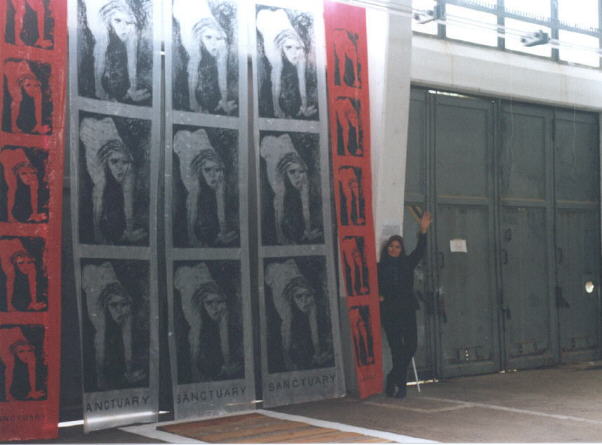
Alone / Allein became the single motif of a larger work, Sanctuary. This was shown at the Panzerhalle in August 1998. The figure was multi-printed on wide lengths of polythene, hanging to make a great curtain. This closed and concealed the great doors where the tanks entered for repair. The maintenance pit, stretching the width of the building, with its covering wooden battens, becomes a path of forgiveness - with "to forgive" conjugated (I forgive, you forgive, he/she forgives...) and written plank by plank, step by step. Te path/pit approaches the sanctuary. It is in the form of two fragile, shimmering images of Alone / Allein drawn enlarged on fine muslin. A libation jar stands by for cleansing.
The Panzerhalle is a huge, brutal building of hard concrete, inhuman of scale and redolent of oppression and repression during a large part of this century. Sanctuary attempts to address the antithesis, with subtlety, humanity, frailty against the physical scale, and to suggest forgiveness and reconciliation.